
By: Anthony Kovatch, MD
“Well, I’ve been afraid of changin’
‘Cause I’ve built my life around you
But time makes you bolder
Even children get older
And I’m getting older too
Oh, I’m getting older too”
– From the song “Landslide,” written by Stevie Nicks
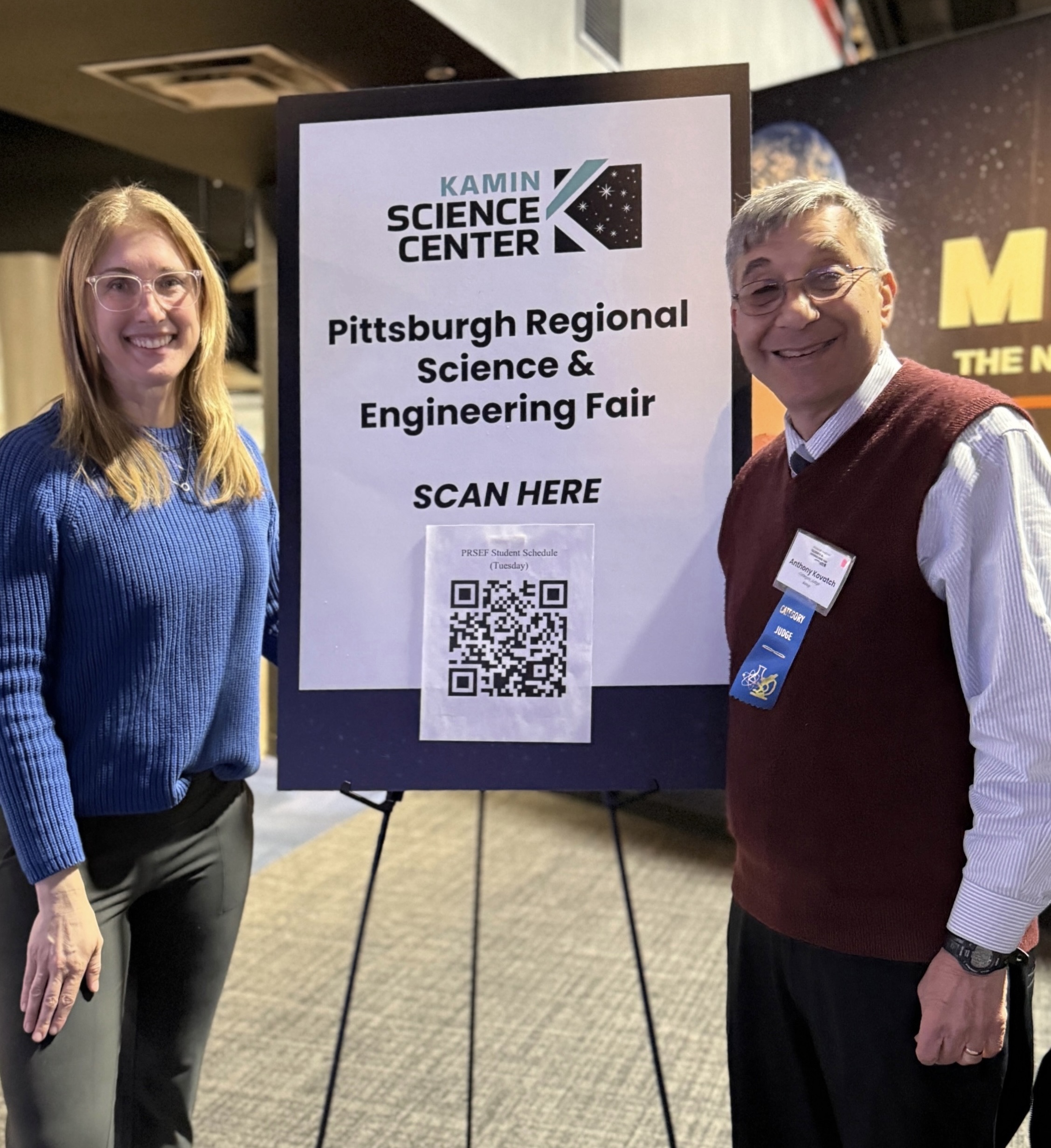
The haunting refrain of the 1975 song by Fleetwood Mac was heightening my anxiety caused by accepting the challenge of being a sponsor judge again for the ACMS at the annual Pittsburgh Regional Science and Engineering Fair on March 24, 2026. Not only was this judge truly getting older and more removed in time from his “glory days” as a scientist and researcher, but the juggernaut of advancing high school student mastery of the scientific method and exploding creativity filled me with trepidation as to my capability to honestly judge. I was greatly relieved when Melanie Mayer, Manager of the ACMS Foundation and mother of similar-aged students, became the Society’s photographer and joined me as an unofficial adjudicator.
I was initially challenged psychologically by the obligation of referring to the institution as the Kamin Science Center; the Carnegie Science Center on Pittsburgh’s Northside officially became the Daniel G. and Carole L. Kamin Science Center in September, 2025, following a transformative $65 million gift from the Kamin family – the largest in the Carnegie Museums’ 130 year history. This transition had followed in the footsteps of the neighboring Steelers Acrisure Stadium, which had previously changed its name from Heinz Field (under which it had been christened) for similar financial purposes.
During the “pre-game” warmup preparing us mentally for the rigors of judging, my anxiety heightened when pressure was exerted on all us judges to follow the prescribed rubric to establish criteria for scientific excellence. I personally could not remember such an emphasis on the “rubric” —a detailed, structured scoring tool that clearly defines and outlines the criteria and performance levels for evaluating student work and describes levels of quality for each criterion. Although admittingly cumbersome to utilize, the rubric provides a transparent framework for assessment, thereby helping both teachers and students understand expectations and supporting formative feedback to enhance learning and formalize the judging process.
I noticed a definite shift away from conglomerate projects managed by 2 or 3 “prodigious” students in the field of science toward a preponderance of solo projects focusing on areas where the individual student had a personal “ax to grind.” There was a diminution of entrees from the “heavy hitters” of the past- prominent large schools in Allegheny County- and a corresponding increase in projects from smaller high schools in the surrounding rural counties of Western Pennsylvania, especially the Laurel Highlands. I was reminded of the admiration of Robert Frost for the lonely country boy:
“I should prefer to have some boy bend them
As he went out and in to fetch the cows—
Some boy too far from town to learn baseball,
Whose only play was what he found himself,
Summer or winter, and could play alone.
– from the poem “Birches” by American poet Robert Frost (1874-1963), renowned for his realistic depictions of rural life
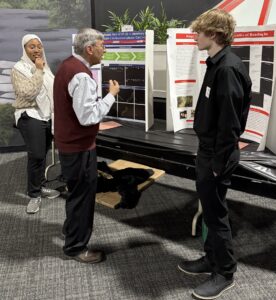
The students had no misgivings about carrying out the research in the comfort of their homes or even in barns (rather than in laboratories at their schools). In addition to the standard topics of recent years (antimicrobial methods, comparative efficacy of cleaning products and sunscreens, biofilms, bioprinting), I sensed a changing focus on investigation into the “science” of nature: compost fertilizer; factors influencing the growth of plants, leaves, and fruit; biological effects of such household staples as papaya juice, caffeine, and aloe vera! A project entitled “Fresh Air in the Barn: The Effects of Livestock Bedding on Ammonia Buildup” garnered a good deal of attention. Perhaps American transcendentalist Ralph Waldo Emerson (1803-1882) was predicting the future of science when he wisely stated: “The best tunes are played on the oldest fiddles.” —the “fiddles” being the natural world around us.
As Melanie and I exited the Kamin Science Center at the end of a long, mentally-taxing day, I wholehearted agreed with her conclusions:
“All I could think was: wow, there is so much talent, thought, and potential here. The projects were fabulous, with an attention to detail that felt very intentional. And honestly, for all the talk about the next generation not having social skills, I found these students to be an absolute delight to talk to. They were well spoken, full of life, and true experts on their topics.”
What is most essential has not changed at all: We contend that the future of science is in very good hands. As well as the future of our civilization!